
Key Takeaways & Protocol Essentials
- Distinguish between observable damage, concealed assembly risks, and unverified finish transitions before assigning line items.
- Never guess concealed material grades or layers; record standardized assumption logs paired with targeted exploratory openings.
- Document cross-sectional boundaries with datum-referenced photos to isolate confirmed damage from speculative repairs.
Categorizing Ambiguity in the Field Inspection
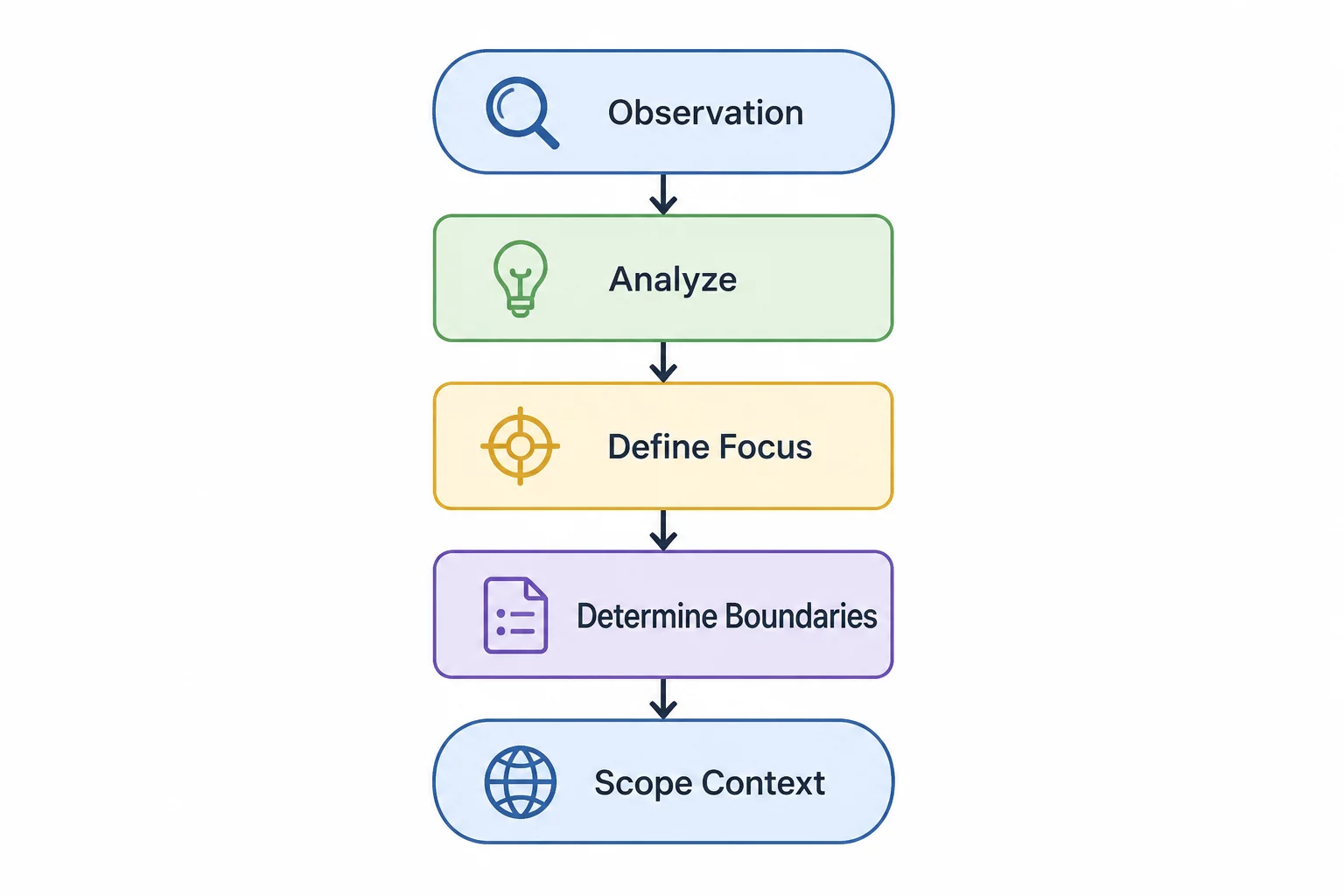
Property inspections routinely uncover situations where physical evidence does not clearly define the scope boundary. A water stain on drywall may terminate behind high-end cabinetry, or finished tongue-and-groove flooring may disappear under built-in millwork without a visible threshold. In such conditions, treating uncertainty as factual damage distorts the repair scope documentation, while ignoring potential underlying substrate failure creates severe operational gaps during reconstruction.
Field reviewers must categorize ambiguity into three distinct tiers: observable variance (where materials differ across transitions), concealed substrate risk (where structural components remain hidden behind intact finishes), and multi-trade overlap (where demolition boundaries impact unaffected mechanical or structural assemblies). Recording the exact classification in field notes ensures transparent estimate scope review and prevents subjective scope expansion.
Core Principles for Managing Uncertain Evidence
Non-destructive thermal or moisture diagnostics must precede any invasive opening, establishing documented probable cause before inspecting concealed framing or cavities.
Every unverified line item must carry an annotated field note detailing the observed trigger, photographic reference, and specific test needed to confirm scope context.
Separate confirmed physical damage line items from conditional substrate allowances to maintain auditable clarity in Xactimate scope context.
Resolving Contradictory Physical Indicators
When field notes indicate conflicting observations—such as elevated moisture readings adjacent to pristine surface paint, or thermal temperature drops without tactile moisture—the documentation must capture both data points without premature reconciliation. Forcing a single narrative over contradictory data compromises the entire inspection trace.
“Ambiguity is not a documentation failure; unrecorded assumptions and speculative line items are. Transparency in field uncertainty protects the integrity of the entire scope review.”
Systematic cross-referencing between elevation photographs, moisture mapping grids, and architectural framing diagrams allows secondary reviewers to isolate anomalous readings. When exploratory removal confirms hidden moisture or structural decay, the preliminary conditional note transitions seamlessly into verified scope context with zero ambiguity.
Field Ambiguity Resolution Framework
| Uncertainty Scenario | Documentation Protocol | Scope Resolution Action |
|---|---|---|
| Concealed Wall Cavity Moisture | Thermal imaging + pinless moisture depth scan with datum marker | Record conditional exploratory allowance; verify substrate condition upon opening |
| Continuous Flooring Boundary | Threshold close-up + layout sketch showing transition points | Map natural break lines; isolate confirmed affected area from continuous expanse |
| Discontinued Exterior Profile | Caliper profile measurement + color-swatch macro photo | Document dimensional mismatch; note code/manufacturer compatibility constraints |

Field Inquiries & Observations
Submit a Field Note or Feedback
Share your site observation insights or questions regarding this methodology.